
Published: October 10, 2026 · 10 min read
You need far less than an art store wants to sell you. A sketchbook, three pencils, a kneaded eraser, two or three good brushes, five tubes of paint, decent paper, and a lamp that shows true color will carry you through your first hundred pieces. Most of what fills a beginner's drawer gets used once.
This guide covers that core kit, what changes by medium, what to skip, and a second, smaller toolkit for the moment you want to sell prints of your work, because that is where a lot of artists suddenly discover they need a scanner, a ruler, and a way to show size.
Table of Contents
- The core kit
- What changes by medium
- Five cheap things that make a bigger difference than they should
- What you can skip at first
- The second toolkit: turning originals into prints
- Building your kit in stages
- FAQ
The core kit
| Tool | What to get | Why it matters |
|---|---|---|
| Sketchbook | A mid-weight, spiral-bound book you won't feel precious about | Volume matters more than paper quality at the start |
| Pencils | HB, 2B, and 6B | Three grades cover light lines, mid tones, and darks |
| Eraser | A kneaded eraser | Lifts graphite and charcoal without shredding paper |
| Brushes | A size 4 and size 8 round, plus a 1/2-inch flat | Covers detail, general work, and washes or edges |
| Paint | Five colors: white, a warm yellow, a red, ultramarine blue, burnt umber | A limited palette teaches mixing faster than a 48-tube set |
| Surface | Paper or panels made for your medium | The wrong paper causes more frustration than cheap paint |
| Palette | A white plate, ceramic tile, or plastic palette | Mixing on white shows true color |
| Two water jars | One for rinsing, one clean | Muddy water makes muddy color |
| Masking tape | Low-tack painter's tape | Holds paper flat and gives you clean borders |
Student-grade paint is fine for learning. Artist-grade paint has more pigment and less filler, so colors stay bright when mixed. If you can afford a single upgrade, upgrade your white and your blue first, since they end up in most mixes.
What changes by medium
Watercolor. Paper matters more than anything else here. Cotton paper at 300 gsm (140 lb) handles water without buckling and lets you lift and layer; cheap cellulose paper fights you. A small pan set, a size 8 round brush that comes to a point, and a spray bottle are enough to start. See watercolor painting ideas for first projects.
Acrylic. Heavy-body acrylics hold brush marks; fluid acrylics level out. Acrylic dries fast, so a stay-wet palette (a sponge and baking paper in a lidded box) saves a lot of paint. Canvas panels are cheaper than stretched canvas and easier to store while you practice.
Oil. Add odorless mineral spirits or a solvent-free medium, a rag supply, and ventilation. Oils stay workable for hours, which is forgiving, but they take days to touch-dry, so plan where wet paintings will live.
Gouache. Opaque watercolor that reactivates with water. Good for flat graphic color and illustration, and it scans beautifully because the surface is matte.
Drawing and ink. Add a fine-liner set (0.1 to 0.8 mm), a brush pen, smooth bristol paper, and a white gel pen for highlights.
Digital. A pressure-sensitive tablet and drawing software replace almost all of the above. The trade-off shows up later: you have no physical original to sell, so prints and downloads become the whole business.
Five cheap things that make a bigger difference than they should
- A daylight bulb. A 5000K to 6500K bulb shows color close to how it looks in daylight. Paint under warm yellow light and your work will look cold and blue the next morning.
- A viewfinder. A piece of card with a rectangle cut out, or two L-shaped strips. It helps you decide the crop before you start rather than after.
- A grayscale value scale. Squinting works, but a printed strip from white to black shows you whether your darks are dark enough.
- A palette knife. For mixing without wrecking brushes, and for texture.
- A phone camera. Photograph your painting in black and white halfway through. Value problems you can't see in color become obvious.
What you can skip at first
- Giant sets. A 72-color set teaches you to pick colors instead of mixing them. Five tubes and white will make almost anything.
- A big easel. A tabletop easel, or a board propped on books, is enough until you work larger than about 18x24 inches.
- A brush for every job. Three good brushes beat thirty cheap ones that shed and won't hold a point.
- Expensive canvas. Practice on paper or panels. Save good surfaces for pieces you plan to finish and keep.
If the problem is less what to buy and more what to paint, the free art prompt generator gives you a subject, a medium, and one constraint to work with, and painting ideas for beginners has full step-by-step projects.
The second toolkit: turning originals into prints
Selling a print is a different job from making the painting. The original has to become a high-resolution file, the file has to print at the sizes you offer, and the buyer has to understand how big the print is before ordering. That takes a handful of extra tools.
| Tool | What it does | Notes |
|---|---|---|
| Flatbed scanner | Captures flat work up to about letter or A4 size | Scan at 600 dpi or higher; flat lighting avoids glare on paint |
| Camera and two lights | Captures larger or textured originals | Lights at 45 degrees on each side, camera square to the work |
| Color target or gray card | Keeps color consistent between capture and print | Photograph it once per lighting setup |
| Basic editing software | Crop, straighten, correct color | Free options handle all of this |
| Print resolution check | Tells you the largest size your file can print sharply | Use the free print resolution checker |
| Aspect ratio check | Shows which print sizes fit without cropping | Use the aspect ratio calculator |
| A good print partner | Giclée or archival pigment printing | Order one test print at your largest size before listing it |
| Tape measure | Gives buyers real dimensions | Measure the print, the frame opening, and the outer frame |
| Room mockups | Shows the print at its real size on a wall | The single most asked buyer question is "how big is it?" |
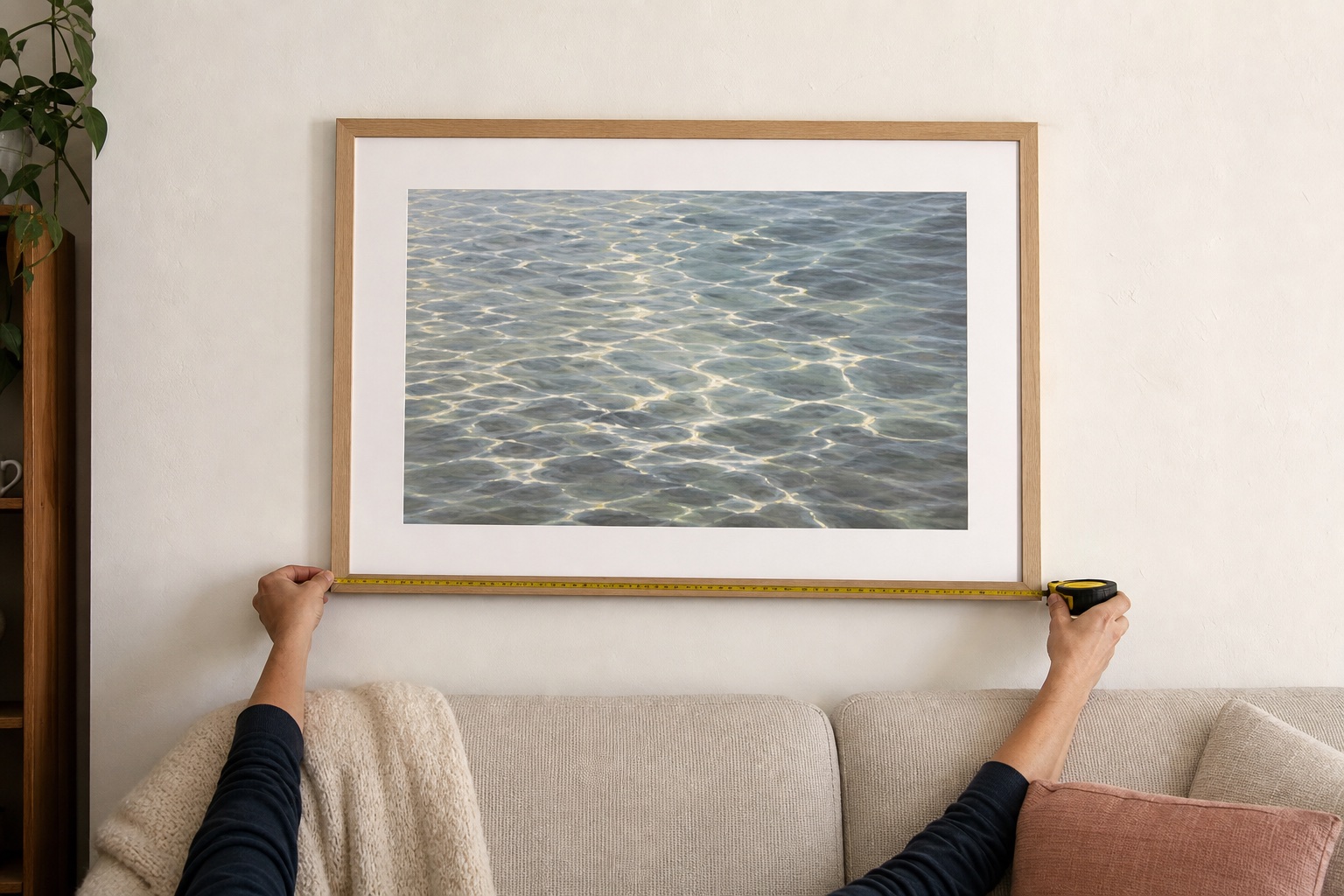
The ratio step catches people out more than anything else. A painting made on a 12x16 canvas is 3:4, which means it prints cleanly at 9x12 or 18x24, but not at 8x10 or 24x36 without cropping or white space. Decide your print sizes before you scan, not after a customer asks.
For the last step, the art mockup generator puts your scan in a real room at the exact size you sell, so an 8x10 looks like an 8x10 and not a poster. It is the image buyers look at first. If you are not sure which sizes to offer, wall art sizes shown to scale shows seven common sizes on the same wall.
Building your kit in stages
| Stage | Add | Skip for now |
|---|---|---|
| First month | Sketchbook, pencils, eraser, one medium's starter kit, daylight bulb | Easel, large canvases, specialty mediums |
| Painting regularly | Artist-grade white and blue, better paper or panels, palette knife | Full artist-grade set |
| Ready to sell | Scanner or camera setup, test prints, tape measure, room mockups | Expensive software, a big print run before you know what sells |
FAQ
What art supplies should a beginner buy first?
A sketchbook, HB, 2B and 6B pencils, a kneaded eraser, a starter set for one medium, two or three good brushes, and paper made for that medium. Add a daylight bulb so you see true color. Everything else can wait until you know what you enjoy.
Do I need expensive paint to start?
No. Student-grade paint is fine for learning. Artist-grade paint has more pigment and mixes cleaner, so upgrade one or two colors you use most, usually white and blue, before buying a full professional set.
What is the difference between student and artist grade paint?
Artist-grade paint has a higher pigment load and fewer fillers, so colors stay strong when mixed and thinned. Student grade often substitutes cheaper pigments, labeled with "hue" in the name, which are fine for practice but can turn muddy in mixes.
What do I need to sell prints of my art?
A way to capture the original at high resolution (a flatbed scanner or a camera with even lighting), basic editing to crop and correct color, a check that the file supports your print sizes, a reliable print partner, and listing images that show the print at its real size, ideally a room mockup.
What resolution should I scan art at for prints?
Scan at 600 dpi or higher for small originals. To print at 300 pixels per inch, the file needs 300 pixels for every inch of the print: a 16x20 inch print needs 4800x6000 pixels. The print resolution checker does the math for any size.