Updated: September 17, 2026 · 24 min read
Your first painting does not need to prove that you are artistic. It needs to give you one clear thing to notice. If a project asks you to draw accurately, mix ten colors, control every edge, and invent a composition at the same time, the finished page cannot tell you which skill needs work. That is not a personal failure. It is a badly chosen exercise.
These 35 painting ideas for beginners are grouped by medium and by the skill they make visible. Eight include complete materials, drawing guidance, timed steps, and recovery advice. Most fit on a surface between 5 x 7 and 8 x 10 inches. Small is friendly here: you can finish, look honestly at the result, and try again before the paint on your palette becomes archaeological evidence.
Table of Contents
- What makes a painting idea beginner-friendly?
- 35 easy painting ideas by medium and skill
- Eight beginner projects with materials and steps
- Common beginner mistakes and what to do instead
- The first session I would recommend
- Finished the piece? What to do next
- FAQ
What makes a painting idea beginner-friendly?
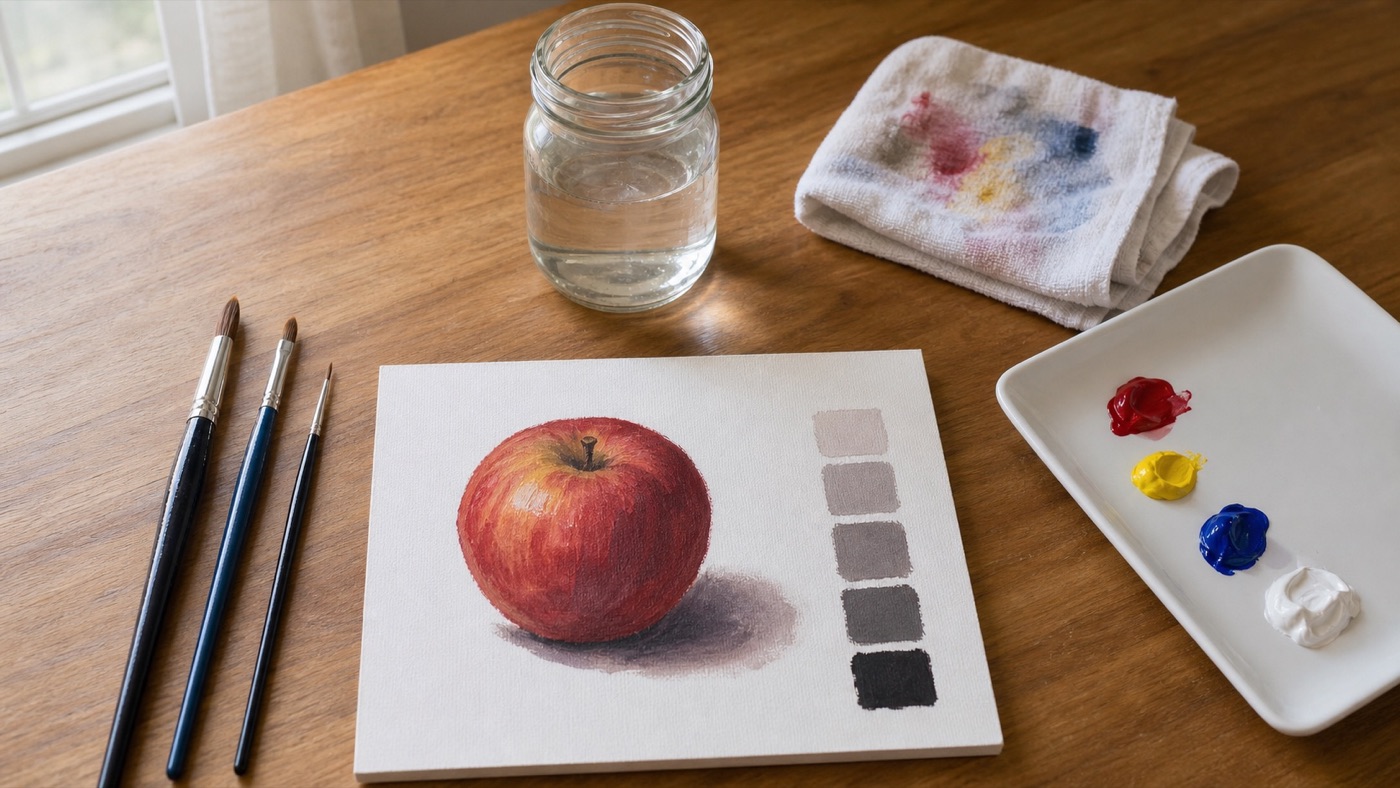
A beginner-friendly project limits new decisions. A detailed portrait asks you to solve proportion, anatomy, value, color, skin edges, and likeness at once. A single apple in three values asks one useful question: can you separate light, middle, and dark clearly enough for the form to turn?
Look for a small surface, a short materials list, a forgiving subject, and one result you can judge after the paint dries. "Did I make a good painting?" is too vague to help. "Does the gradient move from dark blue to white paper without stripes?" gives you somewhere to go next.
This is sequencing, not self-protection. You are not avoiding difficult painting forever. You are learning the ingredients separately so you can recognize them when they appear together. A 25-minute mark sheet can teach more about your brushes than spending three frustrated hours trying to make them imitate fur.
35 easy painting ideas by medium and skill
You do not need to work through these in order. Choose the medium already available, then choose one idea whose result you can evaluate. Each prompt includes a limit because limits are what make the session teachable.
Acrylic ideas
-
Three-value apple or orange. Side-light one fruit and reduce it to light, middle, and shadow before adding a highlight. Use only black, white, and one optional local color so value remains the decision you can judge.
-
Flat-band sunset. Paint three or four horizontal color bands from pale near the horizon to darker above, with no blending requirement. Add one low dark land silhouette only after the bands feel balanced.
-
Simple potted plant. Paint the pot as a tapered cylinder and the leaves as three connected masses rather than many separate symbols. Choose four or five foreground leaves for clearer edges and let the rest stay grouped.
-
Coffee mug under one lamp. Draw the centerline, top ellipse, base ellipse, and handle opening before you paint. Keep the cup to one middle value, one light plane, and one shadow plane until the cylinder reads.
-
Four clean stripes. Tape or draw four unequal bands and fill them with related colors using a flat brush. The subject is paint loading and edge control, so correct gaps while wet and stop before texture distracts you.
-
Small color-wheel composition. Mix orange, green, and violet from the three primaries, then arrange all six hues as circles or wedges. Let one color occupy more space than the others so the result feels like a painting instead of a chart.
-
Cloud over a flat horizon. Paint a plain sky and ground, then build one large cloud from two light shapes and one muted shadow. Leave some sky holes inside the cloud and soften only selected edges.
-
One shape, three palettes. Repeat the same circle, arch, or leaf motif on three small cards. Change only the palette in each version, which makes it easy to see how color alters mood while composition stays constant.
-
Simple house silhouette. Draw a rectangle and roof as one connected dark shape against a light sky. Add one lit window or door only if the silhouette already reads cleanly from across the room.
-
Unequal color-block grid. Divide a small panel into six to nine rectangles of different sizes and fill them with a limited palette. Repeat one color in separated areas so the eye moves around the grid rather than stopping in each box.
Watercolor ideas
-
Two-color wet-on-wet wash. Wet a small sheet evenly, place one color on each side, and tilt once so they meet. Stop while the paper is glossy; late brushing is more likely to create blooms than to improve the blend.
-
Single-pigment gradient. Start with a strong horizontal band and add a measured brushful of water before each band below it. Keep one wet bead moving down the page so the transitions connect rather than dry into stripes.
-
One botanical leaf. Draw the outer leaf shape and main vein only. Paint a pale base, touch a cooler color into the damp shadow side, and wait until the leaf is dry before adding two or three veins.
-
Overlapping transparent circles. Paint one pale circle, dry it fully, then cross it with a second and third transparent color. The new colors should appear where layers overlap, which makes this a simple test of glazing and patience.
-
Salt-texture night card. Paint one dark blue rectangle, wait until the shine turns satin, and sprinkle fine salt over one area. Let it dry completely before brushing the salt away, then turn the texture into a small sky with one dark ground shape.
-
Lifted cloud study. Paint a blue-gray wash and wait until it is damp rather than glossy. Press a crumpled paper towel straight down and lift it straight up to remove cloud shapes without rubbing the paper.
-
Three-value mountains. Mix pale, middle, and dark versions of one pigment. Paint the distant ridge first, let it dry, then overlap the middle and foreground ridges so value alone creates depth.
-
Citrus slice glazing. Reserve pale pith lines between simple wedge shapes and build color in two transparent layers. Alternate wedges while painting so wet neighbors do not run together.
For more work with water ratios, paper states, and drying cues, use 40 Watercolor Painting Ideas for Every Skill Level.
Abstract ideas
-
Two-color shape painting. Choose one warm and one cool color plus white, and premix five variations before touching the surface. Build the painting from three or four unequal shapes, keeping the strongest contrast in one area.
-
One continuous line. Draw one unbroken line that enters and leaves every region of the page, then fill only three of the enclosed shapes. The unpainted paper matters as much as the colored areas.
-
Monochrome value field. Use one hue plus white and a dark neutral to create five values. Arrange them in large blocks, allowing the middle values to connect and the lightest and darkest to meet only once.
-
Palette-knife texture tile. Spread one base color thinly, let it dry, then drag a second color across it with the knife held low. Stop after several broken passes so the underlayer remains visible between ridges.
-
Palette borrowed from a photo. Choose any photo on your phone and mix four colors from it without painting the subject. Use the largest color for most of the surface and reserve the smallest accent color for one or two marks.
-
Tape-resist arcs. Mask two or three broad arcs with low-tack tape, paint over them, and peel while the acrylic is touch-dry. Add one small counter-shape after the reveal so the clean geometry does not feel mechanically centered.
-
Repeated mark field. Pick one mark your brush makes naturally, such as a comma, dash, or press-and-lift leaf. Repeat it in clusters with changes in spacing and value, leaving one area quiet so the pattern can breathe.
For more advanced acrylic and mixed-media constraints, see 50 Abstract Painting Ideas to Try This Week.
One-skill studies
-
Five-step value scale. Mix five distinct grays, place them in order, and repaint any pair that merges when you squint. This small exercise becomes the palette for the value-only object study below.
-
Primary-color mixing grid. Use one red, one yellow, and one blue to mix secondaries and muted neutrals. Record the actual paint mixtures rather than trying to match an ideal color wheel from memory.
-
Pressure-control lines. Load one round brush and make lines that move from thin to thick and back without reloading. Notice whether the change comes from pressure, angle, or speed, then repeat the motion more slowly.
-
Hard-and-soft edge sphere. Paint a simple sphere with one crisp light-side contour and one softened shadow-side contour. Give the cast shadow a firm edge near the sphere and a softer edge farther away.
-
Transparent layer ladder. Paint one thin stripe, let it dry, overlap it with a second, then overlap part of both with a third. Keep each layer fluid and similar in strength so the increasing depth comes from layering, not thicker paint.
-
Negative-space plant. Place a simple branch or plant against plain paper and paint the background shapes around it. Refine only enough gaps for the silhouette to read, then add one interior accent.
-
Warm and cool neutral study. Mix one neutral leaning warm and one leaning cool, then paint a simple cube or folded paper form. Use temperature shifts inside the same value family rather than reaching for brighter color.
-
One brush, six marks. With a single flat brush, make a broad stroke, narrow edge stroke, corner mark, dry drag, curve, and press-and-lift shape. Combine the six marks into a small nonrepresentational study without switching tools.
-
Lost-edge object study. Paint a simple dark object against a dark background and allow one side to disappear where values match. Keep another edge clear and add a small light accent so the viewer completes the missing contour.
-
Three thumbnails of one subject. Before a larger painting, draw the same subject in three two-inch rectangles with different crops and light-dark patterns. Spend three minutes per thumbnail and choose the one that reads best at arm's length.
Eight beginner projects with materials and steps
These exercises are intentionally small and specific. Acrylic can be substituted with gouache for all opaque-paint projects. If you use oils, keep the same sequence but allow more time and use a suitable painting surface.
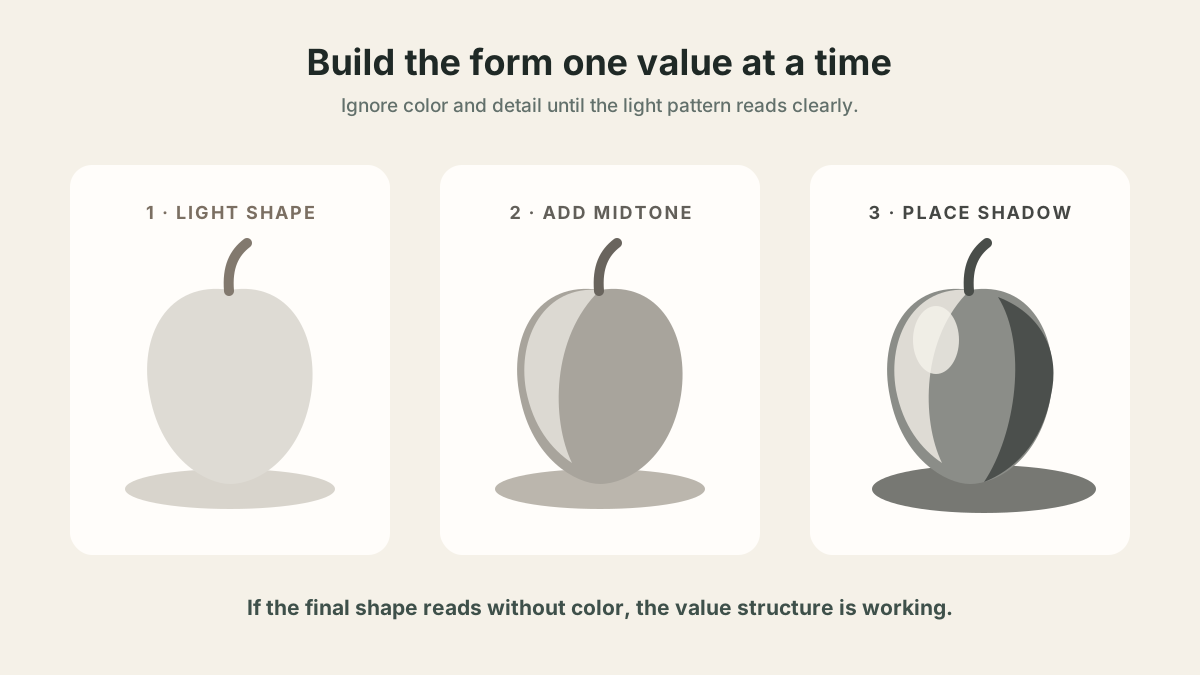
1. Three-value fruit
Things you'll learn: How value creates form before detail or realistic color enters the painting.
Time: 35 to 45 minutes.
Materials: One apple, pear, or orange; one lamp; 6 x 8 inch canvas paper; black and white acrylic plus one optional color; medium filbert brush; pencil; phone camera.
- Set one obvious light direction. Put the fruit on plain paper and place the lamp above and to one side. Turn the fruit until the stem or indentation is visible. Photograph the setup so a bumped table does not end the exercise.
- Draw the outer shape and shadow. Mark top, bottom, widest points, stem angle, and the direction of the cast shadow. Connect them with a light contour. Do not shade the drawing; the paint shapes will do that work.
- Premix three distinct values. Make a middle gray, a much lighter gray, and a much darker gray. Fill the fruit with the middle, add one connected light shape, then one connected shadow shape. Avoid blending every border.
- Ground and test the form. Paint the cast shadow and the darkest contact point directly under the fruit. Add one small highlight only if it appears in the setup. Photograph the dry study in grayscale and view it as a thumbnail.
How to judge it: The fruit should turn in space when seen small. Surface marks and color cannot rescue a light, middle, and dark that are too similar.
Failure mode and recovery: If the fruit looks flat, repaint either the light or shadow as a larger, clearer family. If it looks striped, soften only a short part of the middle-to-shadow boundary with a clean damp brush.
2. Watercolor gradient sky
Things you'll learn: How dilution and a moving wet bead create a smooth value change.
Time: 20 minutes to paint, plus 30 minutes of drying.
Materials: 7 x 10 inch 300 gsm watercolor paper; Ultramarine Blue or Cobalt Blue; 1 inch flat wash brush or large round; palette with a wide well; two water containers; board and tape.
- Mix more paint than seems necessary. Prepare a generous puddle about the color of strong tea. Tape the dry sheet to a board and raise the top edge by roughly two inches.
- Start with a loaded brush. Paint one horizontal stroke across the top. The slight tilt should form a wet bead along the lower edge. Reload and overlap the lower third of that stroke before it loses its shine.
- Dilute in measured steps. Add one brushful of clean water to the palette puddle after each band, then overlap the previous bead. Keep moving downward without returning to the upper area.
- Finish and leave it alone. Use nearly clear water for the final two bands, then lay the board flat. Blot only a heavy bead at the bottom edge. Do not brush back into the wash while it turns from glossy to satin.
How to judge it: The dry wash should move from strong color to almost white paper without separate dark bars.
Failure mode and recovery: If stripes appear while the page is glossy, pass a clean damp flat brush once across the join. If they are already dry, add one very pale full-page glaze later instead of scrubbing individual seams.
3. Two-color abstract
Things you'll learn: How a tight palette can create variety, unity, and a focal point without representational drawing.
Time: 40 to 55 minutes.
Materials: 8 x 10 inch canvas paper; one warm acrylic color, one cool acrylic color, and Titanium White; medium flat and small round brushes; palette knife or mixing brush; scrap paper.
- Choose colors that can make useful neutrals. A warm red and deep blue are friendly, but any warm-cool pair will work. Mix five piles before painting: each pure color, one mixture leaning warm, one leaning cool, and one pale tint.
- Plan three unequal masses. On scrap paper, draw three thumbnail rectangles and divide each into one large, one middle, and one small shape. Choose the version with the least centered arrangement. The thumbnail should take five minutes, not become a separate artwork.
- Place the largest shapes first. Cover about half the surface with the dominant mixture, then add the second large shape. Leave irregular gaps of paper or ground rather than filling every corner immediately.
- Use contrast once. Connect areas with the remaining mixtures and place the lightest beside the darkest in one focal area. Repeat one small color elsewhere, then stop before every region has the same number of marks.
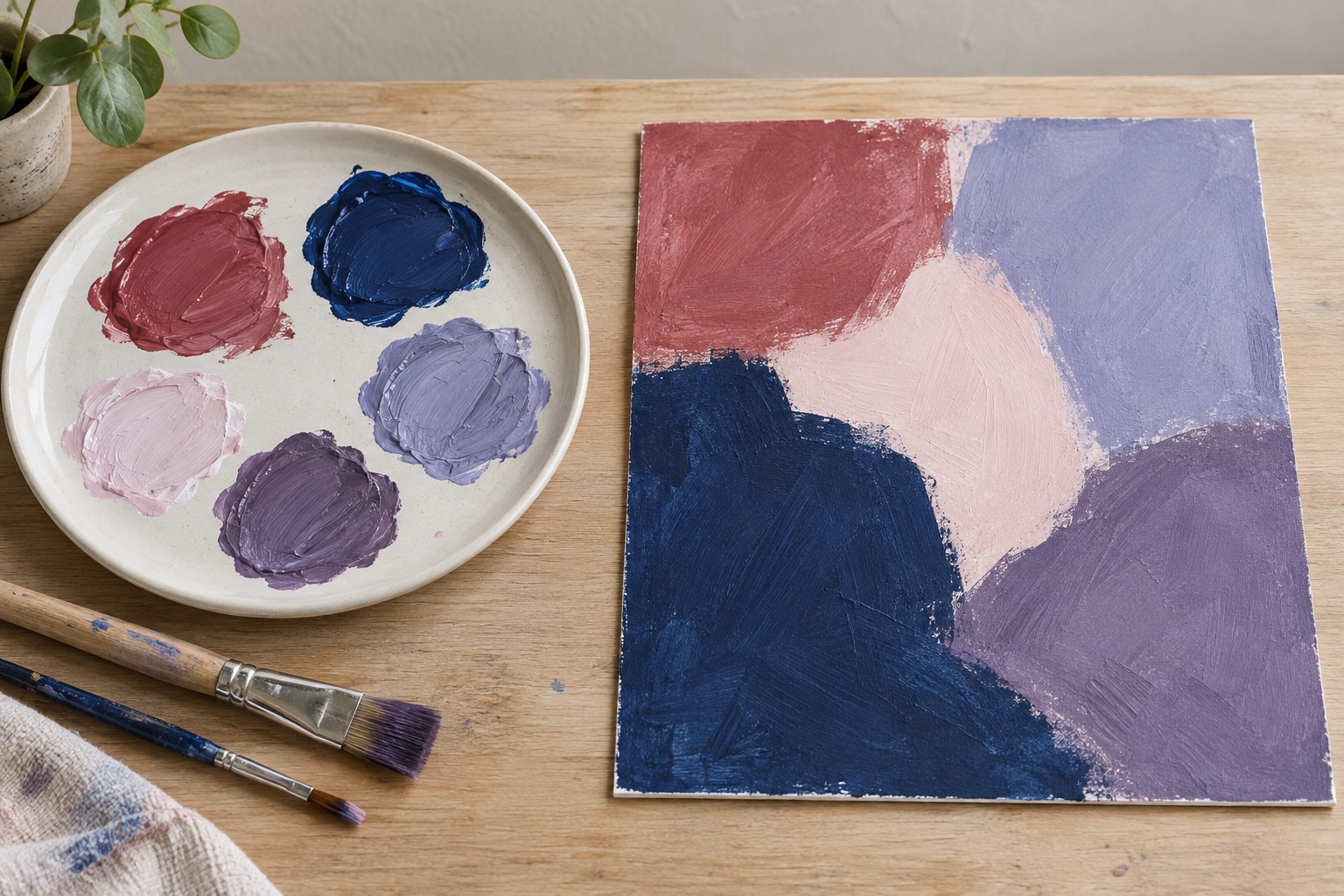
How to judge it: Every color should feel related, one area should attract the eye first, and at least one part of the painting should stay quiet.
Failure mode and recovery: If the painting feels like unrelated patches, glaze or repaint one mixture through two separated areas to connect them. If everything competes, enlarge the dominant shape and soften contrast in two secondary areas.
4. Value-only object study
Things you'll learn: How to see light and form without relying on local color.
Time: 50 to 65 minutes.
Materials: One simple object such as a jar, shoe, or folded paper; one lamp; 8 x 10 inch panel; black and white acrylic or gouache; flat and round brushes; five-step value scale; viewfinder.
- Make the value scale first. Mix five grays from white to black and place a swatch of each on scrap paper. Squint at them. Adjust any neighboring pair that merges.
- Draw the largest proportions. Mark the object's bounding box, centerline if it has one, and cast-shadow direction. Ignore labels, seams, and texture. Compare height to width before refining the contour.
- Block the biggest families. Paint the background and tabletop, then cover the object with the middle value closest to most of its surface. Add the broad light and shadow families using the premixed steps.
- Reserve the extremes. Use the lightest light and darkest dark only near the focal area or contact point. Check the study in a mirror or phone photo, where drawing and value errors often become easier to see.
How to judge it: The object and light direction should remain clear with no color information at all.
Failure mode and recovery: If every plane sits in the middle, compare the painting to your value scale and push one connected light and shadow farther apart. Do not pepper the object with isolated black and white accents.
5. Primary-color mixing grid
Things you'll learn: What secondary colors and neutrals your actual red, yellow, and blue can produce.
Time: 45 to 60 minutes.
Materials: One red, one yellow, one blue, and white acrylic or gouache; 8 x 10 inch heavy paper; ruler; pencil; medium flat brush; palette knife; two water containers.
- Draw a loose nine-cell grid. Leave narrow paper gaps between cells so colors do not touch while wet. Make the cells slightly unequal if you want the result to read as a small composition.
- Place the primaries. Paint red, yellow, and blue in nonadjacent cells. Use an even layer and clean the brush thoroughly between colors; a dirty brush can make the later mixtures look dull before the experiment begins.
- Mix the secondaries from scratch. Combine red and yellow for orange, yellow and blue for green, and blue and red for violet. Adjust the proportion until each mixture clearly belongs between its parents, then paint one cell.
- Use the final cells for discovery. Mix a light tint, a three-primary neutral, and one secondary shifted toward a parent color. Write mixture notes on the back after the page dries.
How to judge it: You should have a practical map of this exact palette, including its limitations. A subdued violet is still useful information.
Failure mode and recovery: Muddy mixtures often come from an unclean brush or from combining too much paint at once. Start a fresh pile with the lighter color and introduce the stronger color gradually.
6. Brush-control mark sheet
Things you'll learn: How pressure, angle, speed, moisture, and paint load change the mark from a single brush.
Time: 25 to 35 minutes.
Materials: 9 x 12 inch heavy paper; one dark acrylic, gouache, or watercolor pigment; one round and one flat brush; water or medium; paper towel; scrap paper.
- Test the load. Mix a fluid but not dripping paint and make three strokes on scrap. Notice how many inches the brush travels before the mark breaks. That distance is more useful than guessing whether the brush is "loaded enough."
- Make pressure rows. With the round brush, pull lines from thin to thick and back by changing pressure while keeping speed steady. With the flat brush, repeat using its broad face, narrow edge, and corner.
- Change one variable at a time. Make rows of fast and slow curves, dry drags, dots, twists, and press-and-lift marks. Label the back of the sheet later if you want to remember which brush state produced each texture.
- Build a small pattern. Choose three marks that feel natural and combine them in a four-inch square. Vary spacing and scale, leaving one quiet area instead of filling the whole box evenly.
How to judge it: You should finish knowing what the brush does when wet, damp, dry, upright, and low to the page.
Failure mode and recovery: If every mark looks the same, exaggerate the variable. Blot the brush nearly dry, flood it, hold it vertical, then hold it low. Subtle control is easier after you have seen the extremes.
7. Hard-and-soft edge sphere
Things you'll learn: How edge changes make a form turn and make its cast shadow sit on a surface.
Time: 40 to 55 minutes.
Materials: 8 x 8 inch panel or canvas paper; black, white, and one acrylic color; medium filbert and clean soft brush; round object to trace; pencil; value scale.
- Plan the light and shadow. Draw a circle, mark the light direction, and sketch an oval cast shadow moving away from the light. Keep the shadow attached to the sphere at the contact point.
- Block the value families. Fill the sphere with a middle value, add a broad light shape on the light-facing side, and a darker core shadow on the opposite side. Keep reflected light darker than the middle value.
- Assign different edges. Keep part of the light-side outer contour crisp against the background. On the shadow side, use a clean damp brush to soften a short section where values approach each other.
- Finish the cast shadow. Paint it darkest and sharpest beside the sphere, then gradually soften and lighten it as it travels away. Add a restrained highlight and check that the sphere still feels painted rather than polished plastic.
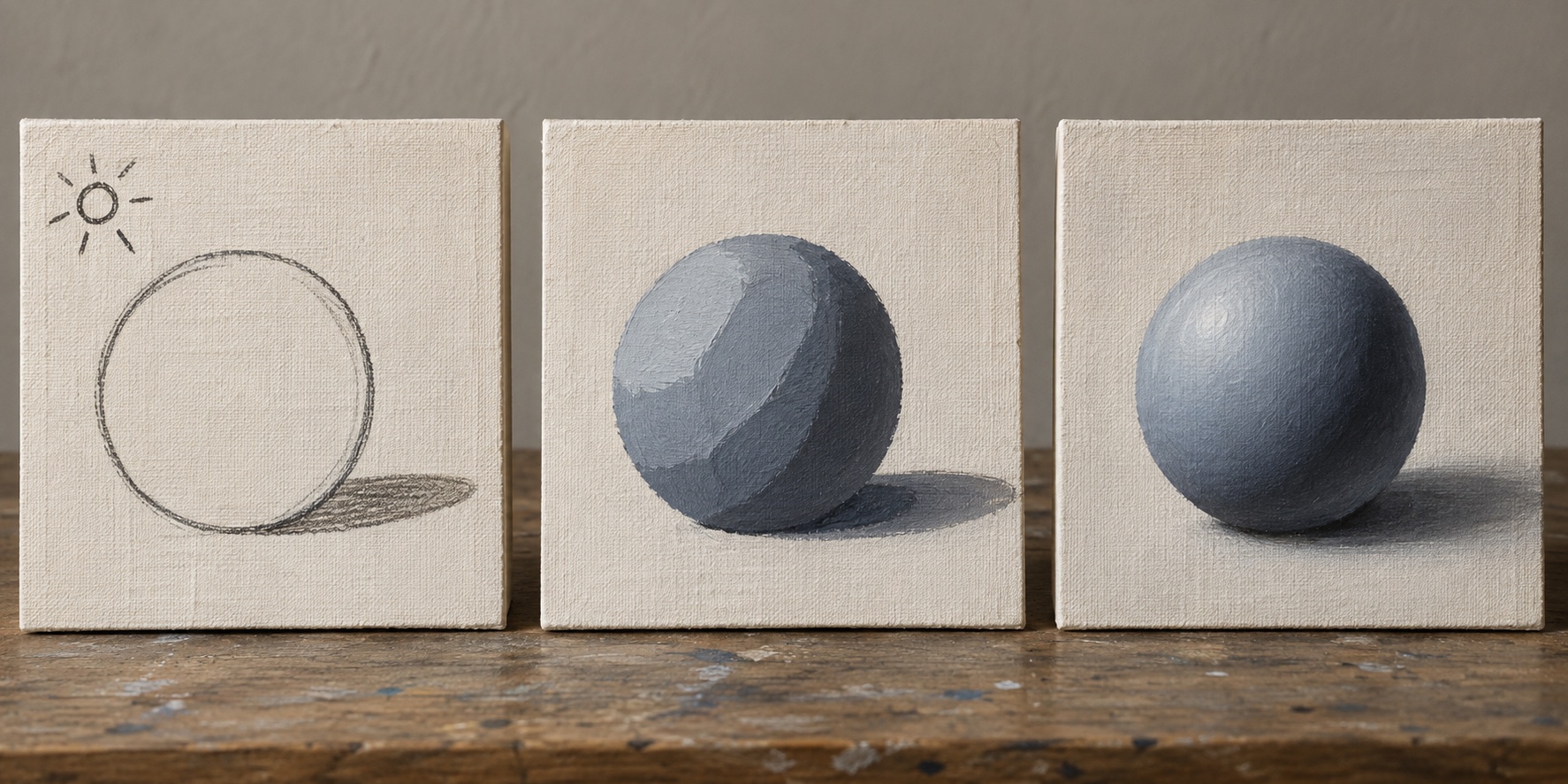
How to judge it: The sphere should feel attached to the surface, and one side should turn into the background more gently than the other.
Failure mode and recovery: If it looks cut out, soften only a portion of the shadow-side contour. If it floats, strengthen the small contact shadow directly beneath it before darkening the whole cast shadow.
8. Negative-space plant study
Things you'll learn: How to see and paint the shapes around a subject, reducing pressure to draw every leaf correctly.
Time: 50 to 70 minutes.
Materials: Simple branch or small broad-leaf plant; plain wall or card; 8 x 10 inch canvas paper; one background acrylic color plus white; medium flat and small round brushes; pencil; viewfinder.
- Choose a readable silhouette. Rotate the plant until several leaves separate clearly and the gaps vary in size. Crop tightly enough that one or two leaves leave the picture edge.
- Mark only the outer limits. Draw the top, bottom, left, and right points, then place the main stem and a few largest leaves. Do not complete every contour; the background will construct them.
- Paint the outside shapes. Start at the corners and fill the background around the plant, treating each gap between leaves as its own puzzle piece. Use the small brush only where two shapes nearly meet.
- Refine selectively. Step back and identify the minimum edges needed for the plant to read. Correct those background shapes, then add one or two interior accents inside the reserved plant. Leave most of it as raw surface.
How to judge it: The plant should read clearly even though you painted mainly what was not the plant.
Failure mode and recovery: If a leaf becomes too narrow, let the paint dry and restore its edge with the untouched-surface color or an opaque light mixture. If every leaf is equally crisp, soften two background edges so the silhouette has hierarchy.
Common beginner mistakes and what to do instead
- Starting too large. A large canvas consumes paint and turns every correction into a bigger decision. Use a surface you can cover with your largest brush in a few minutes.
- Buying a color for every object. A limited palette teaches mixing and keeps the result related. Start with three primaries, white, and one dark earth color if you are using opaque paint.
- Drawing with a tiny brush. Small brushes invite detail before proportion is settled. Block the largest shape with the largest comfortable brush, then move down only when the structure works.
- Blending everything. Form needs both transitions and clear value shapes. Soften where a form turns gradually, but preserve hard edges where planes meet or the focal point needs clarity.
- Correcting wet acrylic repeatedly. Half-dry acrylic lifts and pills. If a passage becomes sticky, let it dry completely and repaint it with a clean layer.
- Judging a watercolor while glossy. Watercolor dries lighter and edges settle. Wait until the page is bone-dry before deciding whether it needs another glaze.
- Comparing a study to a finished professional painting. Compare the result with the stated skill. A rough sphere with convincing edges succeeded at its job.
- Hiding every unsuccessful sheet. Date the study and write one sentence on the back about what you would change. A small stack of honest attempts is a better teacher than one endlessly repaired page.
The first session I would recommend
Start with the three-value fruit, even if the two-color abstract looks more exciting. Use one small sheet, one fruit, black, and white. Add local color only after the three values read. Forty minutes is enough.
When the timer ends, photograph the study in grayscale. If the fruit still turns from light into shadow, the session did its job. If it flattens, you have a specific next move: make the value families clearer and repeat the exercise. That is much kinder and more useful than concluding you are "bad at painting."
If the larger problem is choosing a subject rather than choosing a beginner exercise, use What Should I Paint? A Decision Framework for Artists to narrow the decision by time, medium, and purpose.
Finished the piece? What to do next
Write the date, medium, and one lesson on the back. Keep the painting if it shows you something, not only if it looks decorative. Photograph it square to the surface in even light so you can compare repeated exercises fairly.
When a study begins to feel like a piece you might print or hang, put it in the WallMockup editor at its actual dimensions. The room view reveals whether the value pattern survives at normal distance. If selling work is a future goal, why realistic mockups increase art sales explains how clear scale and presentation help someone understand a piece.
FAQ
What is the easiest painting idea for a complete beginner?
A single piece of fruit painted in three values is one of the clearest first exercises. It uses a familiar, forgiving form and gives you one result to judge: whether light, middle, and shadow make the fruit feel solid.
Do I need expensive materials to start painting?
No. For acrylic or gouache, a small primary-color set, white, two brushes, a palette, and heavy paper are enough. For watercolor, spend a little more on proper watercolor paper before buying many pigments; paper behavior affects the result more than a large color collection.
Should beginners start with abstract or realistic painting?
Either can work. Abstract exercises lower the pressure of matching a subject and are excellent for color, mark, and composition practice. A simple realistic study gives clearer feedback about value and drawing. Choose the kind of feedback you want that day.
How long should a beginner painting take?
Most exercises in this guide take 20 to 70 minutes, plus drying time. A short session is long enough when the chosen skill is visible. Extending the session just to make the page look finished can blur the lesson.
What's the difference between a practice painting and a finished piece?
A practice painting is designed to answer one skill question and can stop as soon as that answer is visible. A finished piece also has to resolve composition, surface, edges, and presentation as a whole. Deciding which one you are making prevents a useful exercise from becoming an accidental five-hour commitment.
See also: The Complete Guide to Wall Art Mockups for how presentation fits into finishing, photographing, and eventually selling your work.