Updated: July 19, 2026 · 7 min read
Acrylics are already on the table. You have 45 minutes, the painting is for yourself, and it is allowed to be practice. "What should I paint?" is suddenly a much smaller question. This guide uses those four constraints - medium, time, audience, and finish level - to reach a workable subject before another round of browsing adds more options.
Table of Contents
- Why "what should I paint" is the wrong first question
- Question 1: What medium do you already have ready?
- Question 2: How much time do you really have?
- Question 3: Who is this painting for?
- Question 4: Does this need to be a finished piece?
- Put the four answers together
- When to just pick from a list instead
- Finished the piece? What to do next
Why "what should I paint" is the wrong first question
Asking "what should I paint?" treats the problem as a search for the right subject, so the natural response is to browse - more reference photos, more idea lists, more inspiration accounts. That can make the decision harder, because every new option is one more thing to compare against everything else you've already seen.
A shortage of subjects is rarely the real blocker. Too many open variables at once usually is. Medium, time, audience, and finish level are often all undecided at the same time, so no single idea feels obviously right. Fix those four variables first, in order, and the subject question gets a lot easier to answer.
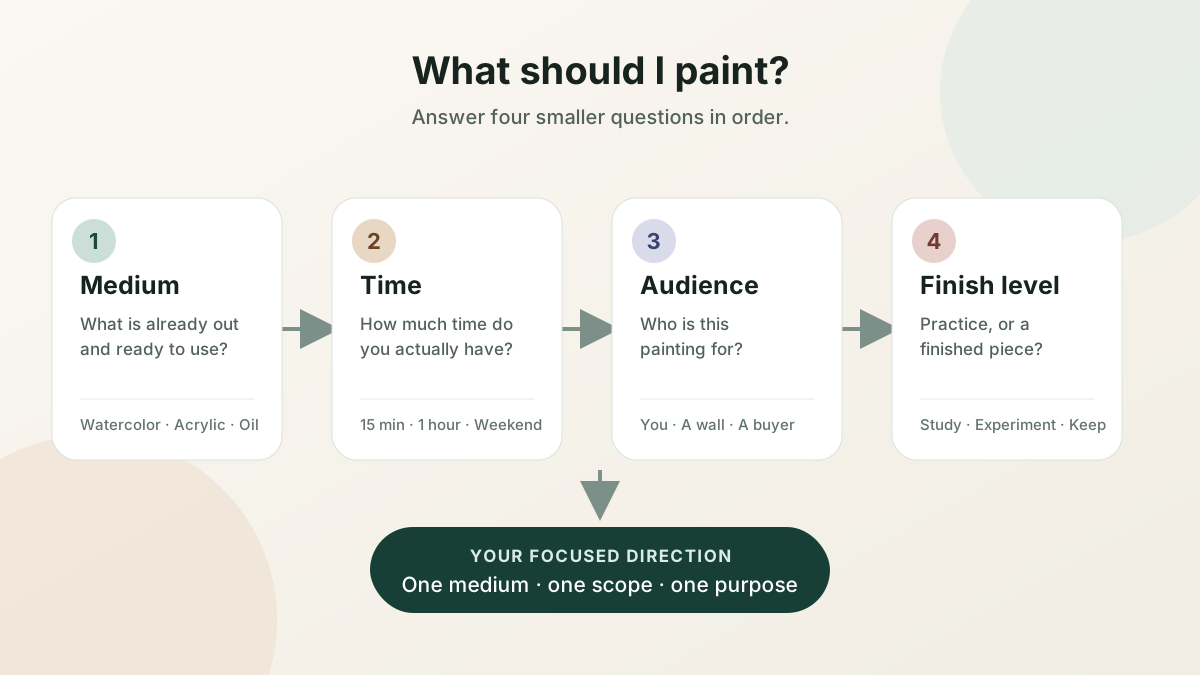
Question 1: What medium do you already have ready?
Don't start from "what do I feel like painting" - start from what's already set up. If your watercolors are out and your acrylics are put away, the honest answer is a watercolor piece, regardless of what subject first comes to mind. Choosing a medium you'd have to dig out or buy supplies for is itself a form of procrastination.
If nothing is set up, pick the medium with the lowest setup cost for today specifically. That might be different from your "main" medium, and that's fine - a quick gouache sketch still counts as painting.
Question 2: How much time do you really have?
Be specific: fifteen minutes, one afternoon, or a weekend. This alone eliminates most subjects. An ambitious multi-layered landscape doesn't fit in fifteen minutes. A single gesture study doesn't need a whole weekend.
- Fifteen minutes or less: a single-element study - one shape, one color relationship, one gesture.
- An hour to an afternoon: a simplified subject with two or three values or elements.
- A weekend or longer: a layered, multi-element piece, or a small series.
This is also where most people overcommit. Pick a subject that needs a full day when you only have an hour, and you'll either rush it or abandon it - and both feel like failure, when the real problem was just a bad time estimate.
Question 3: Who is this painting for?
This question changes more than it seems like it should. A painting for yourself can be as rough or as strange as you want. A painting meant for a specific wall in your home needs to fit that wall's size and color palette. A painting meant to sell needs to consider what a buyer will actually want to live with.
None of these are "better" than the others, but conflating them can cause a familiar kind of painter's block: starting a piece for yourself and then second-guessing it against what might sell, or starting a commercial piece and resenting that it isn't more personal. Decide which one this is before you pick a subject, not after.
If you can't tell which one applies, default to "for yourself." That removes the need to predict an external audience, and a piece made for yourself can still be reconsidered for a wall or a buyer afterward.
Question 4: Does this need to be a finished piece?
A lot of painting sessions stall because "finished, framed, ready to hang" and "practice, might not work, that's fine" are treated as the same goal. They aren't, and they call for different subjects.
If the goal is practice, pick something you're not attached to - a subject you'd be fine abandoning halfway through. If the goal is a finished piece, pick something within a range you've already succeeded at before, and save the experimental technique for the practice session instead.
A useful rule: if you can't answer whether this is practice or a finished piece before you start, treat it as practice. You can always decide afterward that it turned out well enough to keep.
This also explains why the same subject can feel completely different to paint on two different days. The subject hasn't changed - your quiet expectation that this one has to be "the good one" has. Say that expectation out loud before the first mark, and most of the mid-painting hesitation goes with it.
Put the four answers together
Once you've answered all four, the subject question narrows fast. For example: acrylic (medium), one hour (time), for yourself (audience), practice (finish level) points toward something like a quick color-field study or a loose single-object study - not a detailed, multi-figure scene.
Run through your own four answers now, out loud or on paper, before you look at any idea list. Most of the time, one or two subjects will already come to mind once the variables are fixed, and you won't need a list at all.
Try a second example: oil paint (medium), a full weekend (time), for a specific wall in your living room (audience), wants to be finished (finish level). That combination rules out quick gesture studies and rules out anything too experimental to trust with a whole weekend - it points toward a composition you've already got some confidence in, sized and colored to fit the room you have in mind. The subject itself might still be open, but the range of reasonable subjects has already shrunk considerably.
When to just pick from a list instead
Sometimes the four questions land on an answer like "acrylic, an hour, for a wall I have in mind, wants to be finished" - clear constraints, but still no specific subject. That's exactly when a curated idea list earns its place, because you're choosing within known limits instead of browsing without any:
- Medium is abstract and open-ended → see 50 Abstract Painting Ideas to Try This Week.
- Medium is watercolor → see 40 Watercolor Painting Ideas for Every Skill Level.
- Subject is a landscape or outdoor scene → see 30 Landscape Painting Ideas, From Simple to Ambitious.
Pick from whichever list matches the medium and time answer you already landed on, instead of reading all three end to end.
Finished the piece? What to do next
Once a piece is done, the question shifts from "what should I paint" to "does this actually work on a wall." Photos taken flat on a table or propped against a couch don't answer that. Drop the piece into the WallMockup editor and preview it at its real size in a room before you decide on a frame, a print size, or whether to post it anywhere.
If question 3 above was "for a shop" or "to sell," that same scaled view can give a buyer context for the judgment you're making now - see why realistic mockups increase art sales for presentation details that can support the decision.
FAQ
Why can't I decide what to paint?
Often because several decisions are unresolved at once - medium, time available, who it's for, and whether it needs to be finished. Fixing those first narrows the subject question to something more manageable.
What should I paint if I only have 15 minutes?
Pick a single-element study: one shape, one gesture, or one color relationship. Complex, multi-element subjects don't fit a short session and will feel unfinished no matter what you choose.
Should I paint for myself or for what sells?
Decide before you start, not partway through. A painting made for yourself can take more risks; a painting made to sell has to account for buyer expectations around size, color, and subject. Switching audiences mid-painting is what usually causes the stall, not either audience on its own.
How do I know if a painting is "finished"?
If you decided going in that it was a finished piece (not practice), it's finished when it matches the intention you set at the start - not when every part feels perfect. Practice pieces don't need a finish line at all.
What's a good painting idea if I have no inspiration at all?
Answer the four questions above first - medium, time, audience, finish level - even without a subject in mind. Once those are fixed, a subject may occur to you without another round of browsing.
See also: The Complete Guide to Wall Art Mockups for how presentation fits into finishing, photographing, and selling a piece once you've decided what to paint.