Updated: September 17, 2026 · 24 min read
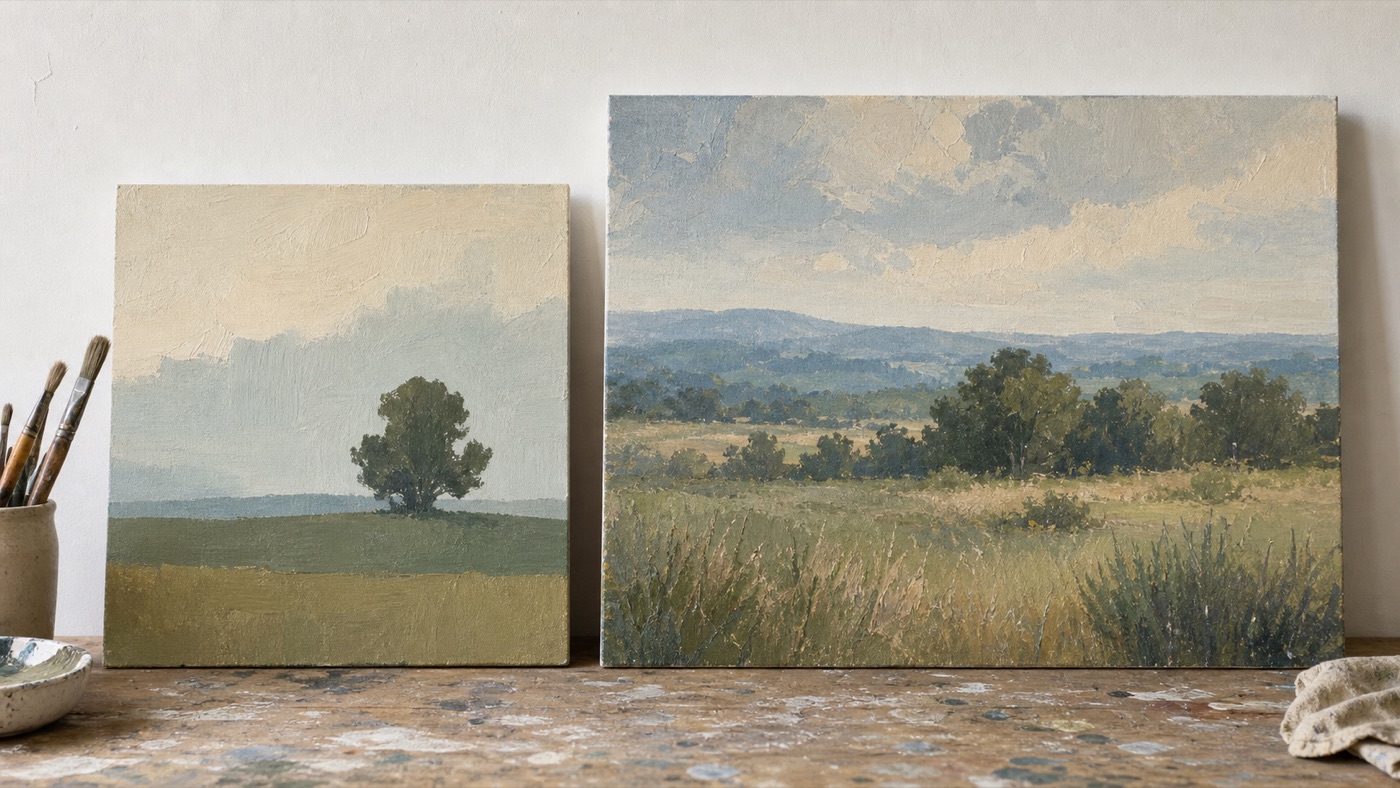
Cover part of a landscape reference with your hand. If the view becomes clearer when a tree, ridge, fence, or building disappears, you have already made the decision that matters most: what to leave out. A landscape is not an inventory of everything that was there. It is a small number of relationships, such as sky to land, near to far, or water to shore, made clear enough that the viewer feels the place.
The 30 landscape painting ideas below move from one-horizon studies to multi-session compositions. Eight include complete drawing and painting instructions, materials, time estimates, and fixes for predictable problems. I have a soft spot for the plain exercises in this list. A field and one tree may not sound dramatic, but it leaves nowhere for weak values to hide, and that honesty is useful.
Table of Contents
- The one decision that makes a landscape work
- 30 landscape ideas by subject and ambition
- Eight landscape projects with materials and steps
- How to paint a landscape from memory
- How to choose one reference and begin
- Finished the piece? What to do with it
- FAQ
The one decision that makes a landscape work
Before choosing colors, decide which relationship carries the scene. A low horizon makes sky the subject. A winding river makes movement into depth the subject. A dark tree against a pale field makes contrast the subject. If you cannot name that relationship in one sentence, the reference probably contains more information than the painting needs.
Make a two-inch thumbnail using three values. If the scene does not read at that size, added detail will not organize it later. Move the horizon, combine tree groups, widen the river, or crop out the building until one idea becomes obvious.
Landscapes are forgiving about literal accuracy and strict about hierarchy. A tree can lean differently from the reference and still feel true; five equally detailed layers will usually feel flat no matter how accurately they are copied. Simplify first, then spend detail only where the eye should land.
30 landscape ideas by subject and ambition
These are not one-line subjects to copy. Each one includes the constraint that makes it useful. The same idea can be painted in acrylic, gouache, oil, or watercolor, although drying order and corrections will differ.
Simple landscape studies
-
A single horizon. Divide a small panel into sky and land or sky and water, placing the horizon clearly above or below center. Use one color shift near the horizon and no objects, so proportion and value have to create the sense of place.
-
One tree against open sky. Place the tree off-center and give it more empty space on one side. Build the canopy from three connected masses, then use a few gaps and branch accents rather than painting individual leaves.
-
A three-shape tree line. Reduce distant, middle, and foreground vegetation to three overlapping silhouettes. Keep the far shape pale and soft, the middle one clearer, and the nearest one darkest so depth comes from value rather than detail.
-
An empty field. Paint no trees, buildings, or figures. Let changes in field color, brush direction, and the width of horizontal bands carry the space from foreground to horizon.
-
A fence line into distance. Place the nearest post large and low, then make each post smaller and closer together as it approaches an off-center vanishing area. Connect them with restrained rails or wire and keep the surrounding field simple.
-
A dirt road over a hill. Start the road wide at a lower corner and narrow it as it rises, allowing it to disappear before the horizon. Curve both road edges toward the same destination instead of drawing parallel ribbons.
-
A hedgerow at dusk. Paint a graded sky first, then add one connected dark silhouette with a varied top edge. Include one or two small gaps or taller shapes so the hedge feels natural without becoming a row of symbols.
-
One rock formation. Choose a boulder with a clear top plane, side plane, and cast shadow. Ignore cracks until the three large planes feel solid, then add only the marks that explain its structure.
-
A minimalist beach horizon. Use sand, water, and sky as three broad bands with different values and temperatures. Break the water band with two or three horizontal light marks, not dozens of equal wave lines.
-
One large cloud. Give the sky at least two thirds of the surface and keep the land as a low anchor. Build the cloud from a pale mass, a cooler underside, and varied lost edges so it feels suspended rather than outlined.
Seasonal landscapes
-
Snow field with one dark accent. Mix the snow from warm and cool near-whites rather than using white alone. Place one tree, fence post, or shed as a small dark anchor and let its cast shadow describe the low winter light.
-
Autumn tree line. Begin with one dark connected tree mass, then place warm red, orange, and ochre notes over it. Leave some dark interior visible so the foliage does not become a bright flat stripe.
-
Early spring tree. Paint the bare trunk and branch structure as the main shape, then add restrained pink, white, or yellow-green accents. A few clustered blooms suggest spring more convincingly than coating every branch.
-
Summer grass field. Establish two or three large green and ochre field bands before making any grass strokes. Use directional marks in the foreground only, allowing the distant field to stay flatter and cooler.
-
Foggy morning field. Keep every mixture close in value and soften edges as they recede. One slightly darker foreground post or grass clump is enough to establish depth against the dissolving distance.
-
Frost at first light. Use a cool blue-gray shadow family and a small warm band where low sunlight catches the ground. Preserve the broad pale surface instead of breaking it into many sparkling dots.
-
Harvest field with hay bales. Arrange bales at varied sizes and angles so they reinforce perspective rather than forming a pattern. Use the nearest bale for texture and simplify the distant ones to warm geometric shapes.
-
Rainy road. Paint the road as a dark, simple perspective shape, then pull a few vertical or horizontal reflections through it while wet. Keep the sky and surroundings muted so the reflected lights have room to matter.
Water and sky landscapes
-
Calm lake reflection. Paint the shoreline first, then repeat its large shapes beneath the waterline with slightly darker, softer color. Break the reflection with only a few horizontal water marks so it still belongs to the lake.
-
Storm front. Build one heavy dark cloud mass against a smaller pale opening, then keep the land low and comparatively quiet. The drama comes from the value interval and cloud direction, not from painting every cloud edge.
-
Sunset over water. Place the lightest warm band near the horizon and repeat it in a narrower path across the water. Anchor the color with one dark silhouette such as a dock, boat, or low tree group.
-
A river bend. Begin the river wide near the lower edge and narrow it through an S curve toward the distance. Strengthen contrast on the foreground banks and soften the far edges so the river leads the eye instead of becoming a flat blue ribbon.
-
A cropped breaking wave. Remove beach and horizon, and study only the wave's large curling shape. Separate the transparent face, foamy crest, and dark trough before adding spray or small foam marks.
-
Night sky over a dark ridge. Reserve most of the surface for a deep varied sky and keep the land as one low silhouette. Add stars in uneven clusters and include one small grounded light only if it helps establish scale.
-
Misty mountain lake. Let the distant mountain edge approach the sky in value and softness. Paint the lake calmer and slightly darker below it, then use one nearer shore shape to prevent the whole scene from dissolving.
Ambitious landscapes
-
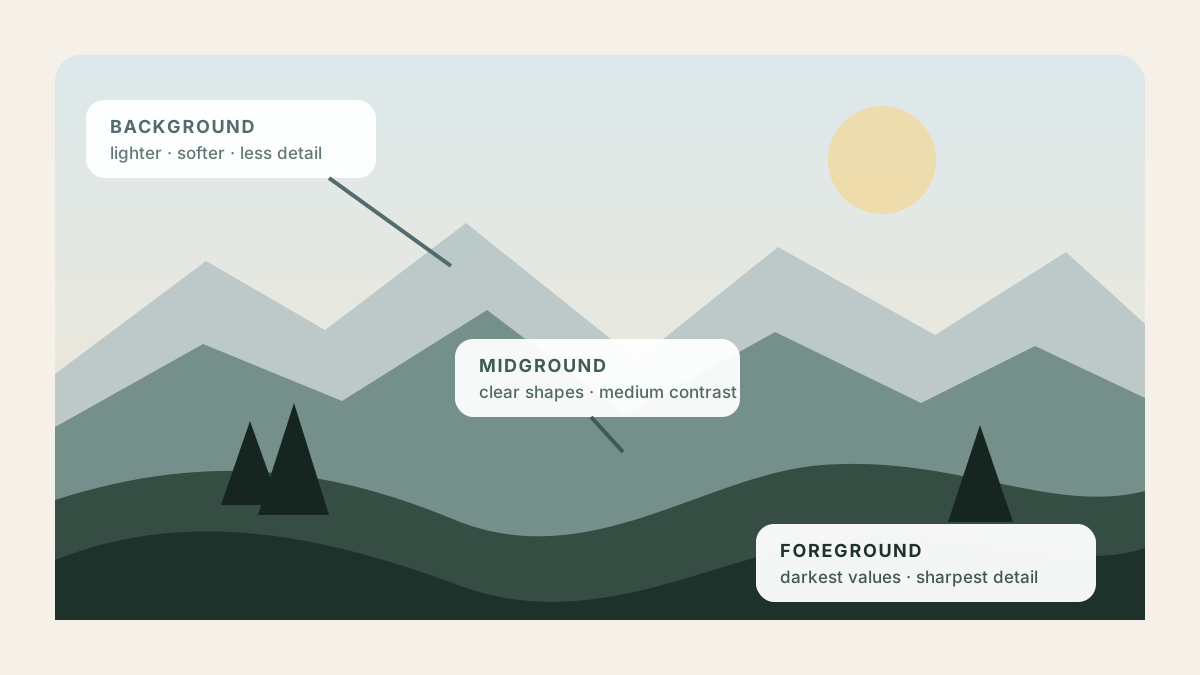
Mountain range with a detailed foreground. Separate sky, distant range, middle slopes, and foreground before beginning. Give each nearer layer more contrast and edge clarity, but concentrate actual texture in one foreground area.
-
Working farm scene. Treat buildings, fields, and figures as part of one value pattern rather than separate illustrations. Simplify architecture into a few planes and use one path, shadow, or fence line to connect it to the land.
-
A multi-season triptych. Transfer the same composition to three panels and keep the main value pattern consistent. Change palette, edge character, and small seasonal details so the panels belong together without becoming duplicates.
-
Forest interior with dappled light. Start from the largest dark interior mass and carve light paths into it. Repeat a few vertical trunks at varied widths, then reserve sharp leaf and bark accents for the area where the light lands.
-
Town at the edge of open land or water. Group the skyline into one interrupted shape before describing individual roofs. Keep the foreground broad and simple so the town feels distant and the built and natural parts remain in the same painting.
Use the depth diagram below as a reminder, not a formula. Every landscape does not need three equally busy layers. Often the background and midground can merge while one foreground shape carries the sense of distance.
Eight landscape projects with materials and steps
These exercises use acrylic or gouache, but the value and drawing sequence also applies to oil. Watercolor painters should work light to dark, let layers dry before overlaps, and replace opaque corrections with reserved paper or glazing.
1. Single horizon study
Things you'll learn: How horizon placement and the proportion of two large value fields can imply a landscape before any object appears.
Time: 25 to 35 minutes.
Materials: 6 x 8 inch panel or heavy paper; two to four acrylic or gouache colors plus white; medium flat brush; low-tack tape; pencil; three thumbnail rectangles.
- Test three horizon positions. In the thumbnails, place the horizon at about one third, one half, and two thirds of the height. Fill sky and ground with two values. Choose the version with the clearest emphasis; avoid center unless stillness is specifically the point.
- Mix two related families. Prepare one sky mixture and one ground or water mixture with a visible value difference. Also mix a small transitional color using a little of both, which will keep the fields related.
- Paint broad and level. Tape the surface and block the larger field first with horizontal strokes. Paint the second field while keeping the horizon deliberate. It can be straight or gently broken, but it should not wobble by accident.
- Add one restrained shift. Place a narrow lighter, cooler, or warmer band near the horizon and soften it into one side. Remove the tape when the paint is touch-dry and stop. Trees and birds would turn this into a different exercise.
How to judge it: From across the room, the panel should feel like open space through proportion, temperature, and value alone.
Failure mode and recovery: If the painting feels cut in half, glaze a narrow transitional band across one side of the horizon or adjust the values so one field clearly dominates. Do not add objects merely to hide an indecisive division.
2. One tree against open sky
Things you'll learn: How to place a focal silhouette, group foliage, and use empty sky as an active shape.
Time: 50 to 70 minutes.
Materials: 8 x 10 inch panel; simple tree reference; Titanium White, Ultramarine Blue, Hansa Yellow, Burnt Umber, and Yellow Ochre; medium flat, medium filbert, and small round brushes; pencil and thumbnail paper.
- Design the empty space first. Draw three thumbnails with the tree left, right, and near center. Keep the horizon low and compare the sky shapes around the canopy. Choose the placement that makes the empty area feel intentional.
- Construct rather than outline. On the panel, mark the horizon, trunk angle, canopy top, widest points, and three major foliage masses. Lightly connect them. Do not draw individual branches through the full canopy.
- Block sky, ground, and tree. Paint a simple sky gradient and a quieter land band. Add the trunk and foliage as one dark connected silhouette, then separate the three canopy masses with a slightly lighter green.
- Open and soften selected areas. Restore a few sky holes, place branch accents near the trunk, and add a cast shadow that grounds the tree. Soften or lose part of the canopy edge into the sky, while keeping the focal side clearer.
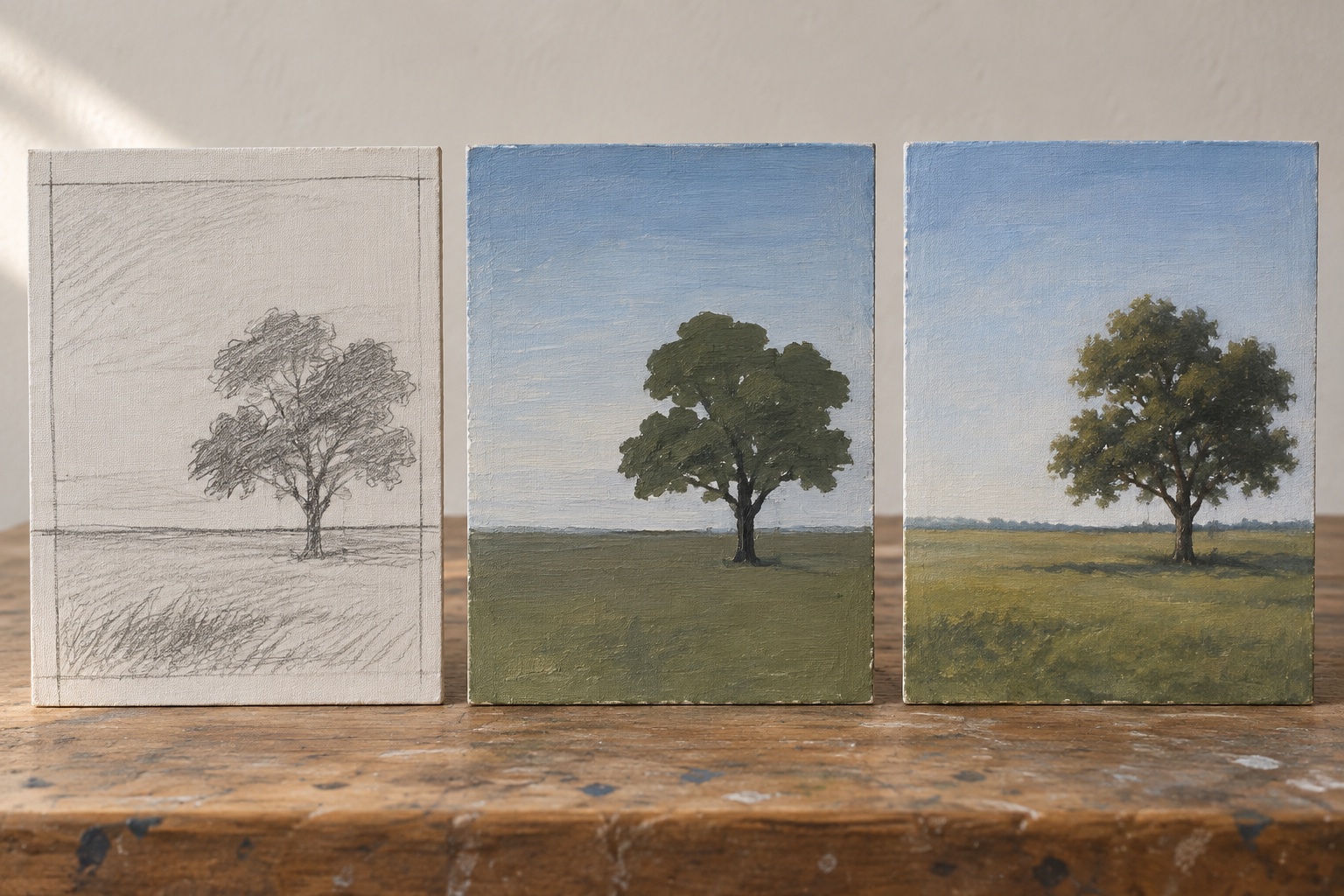
Failure mode and recovery: If the tree resembles a green lollipop, cut two or three irregular sky holes back into the mass and vary the outer contour. If it floats, strengthen the trunk-to-ground contact and cast shadow before adding grass.
3. Foggy field
Things you'll learn: How close values, softened edges, and reduced chroma create atmosphere without making the painting blank.
Time: 45 to 60 minutes.
Materials: 8 x 10 inch panel; cool blue, warm earth color, white, and optional muted green; large soft flat and medium filbert brushes; cloth or paper towel; simple field reference.
- Reduce the reference to four bands. In a thumbnail, mark sky, distant tree line, middle field, and foreground. Remove buildings and small trees unless one is essential for scale.
- Mix within a narrow value range. Prepare a light cool gray, a slightly darker neutral, and two field mixtures. Keep them closer together than feels comfortable. Fog depends on limited contrast.
- Work from atmosphere toward ground. Cover the surface with the light cool mixture. While it is workable, add the distant tree band and soften its upper edge into the sky. Place the middle and foreground bands with gradually stronger color and clearer edges.
- Add one anchor. Paint a fence post, grass clump, or narrow dark edge in the foreground. Keep it small but distinct. Soften any distant passage that competes with it.
How to judge it: The eye should move through several depth bands even though no distant edge is sharp.
Failure mode and recovery: If everything disappears, darken and sharpen only the nearest band and anchor. If it looks like stacked stripes, soften short sections where bands meet and vary their widths rather than blending every boundary.
4. Sunset over water
Things you'll learn: How to relate sky and reflection while controlling the strongest warm-cool contrast.
Time: 60 to 80 minutes.
Materials: 8 x 10 inch panel or 9 x 12 inch watercolor paper; warm yellow, warm red, cool blue, dark neutral, and white for opaque media; 1 inch flat, medium flat, and small round brushes; low-tack tape.
- Choose the light path. Mark a low horizon and place the sun or brightest opening off-center. Sketch a narrow reflection path beneath it. The path can widen toward the viewer, but it should not become a perfect vertical column.
- Paint the sky in broad bands. Place the palest warm mixture near the horizon, move through warmer color, then into cooler upper sky. Blend only enough to connect the bands; some visible brush direction keeps the surface alive.
- Echo rather than copy. Repeat the sky colors in water using shorter horizontal marks and slightly darker values. Interrupt the warm reflection with cool water marks so it feels broken by the surface.
- Add one dark anchor. Paint a low shoreline, dock, boat, or tree silhouette. Keep its reflection narrower, softer, and less detailed than the object above the waterline. Reserve the sharpest contrast near the light path.
How to judge it: Sky and water should feel related but not mirrored like folded paper, and the dark silhouette should supply scale without becoming the subject.
Failure mode and recovery: If the water looks like a second sky, break it with varied horizontal strokes and darken it slightly. If the sunset turns muddy, let the layer dry and glaze one clean warm color over the light path instead of remixing complements while wet.
5. River bend
Things you'll learn: How to draw a believable leading line and use bank contrast to move from foreground to distance.
Time: 90 to 120 minutes.
Materials: 9 x 12 inch panel; simple river reference; Titanium White, Ultramarine Blue, Yellow Ochre, Burnt Sienna, and green or yellow; large flat, medium filbert, and small round brushes; pencil and thumbnail paper.
- Draw the river as a shape, not two lines. In a thumbnail, make the river broad at the lower edge, bend it once or twice, and narrow it toward an off-center distance. Check that both banks converge toward the same area and that the river never becomes an even-width ribbon.
- Place the big depth layers. On the panel, draw the horizon and river shape, then block sky, distant land, left bank, right bank, and water. Keep the far land lighter and cooler than the foreground banks.
- Connect water to sky. Use a slightly darker version of the sky mixture in the river. Add horizontal temperature shifts and a few broken reflections, but preserve the large water shape so it continues to lead the eye.
- Spend detail on the near banks. Strengthen dark accents and vegetation texture near the lower corners, reducing size and contrast toward the bend. Avoid outlining both banks continuously; let several edges soften or disappear in reflection.
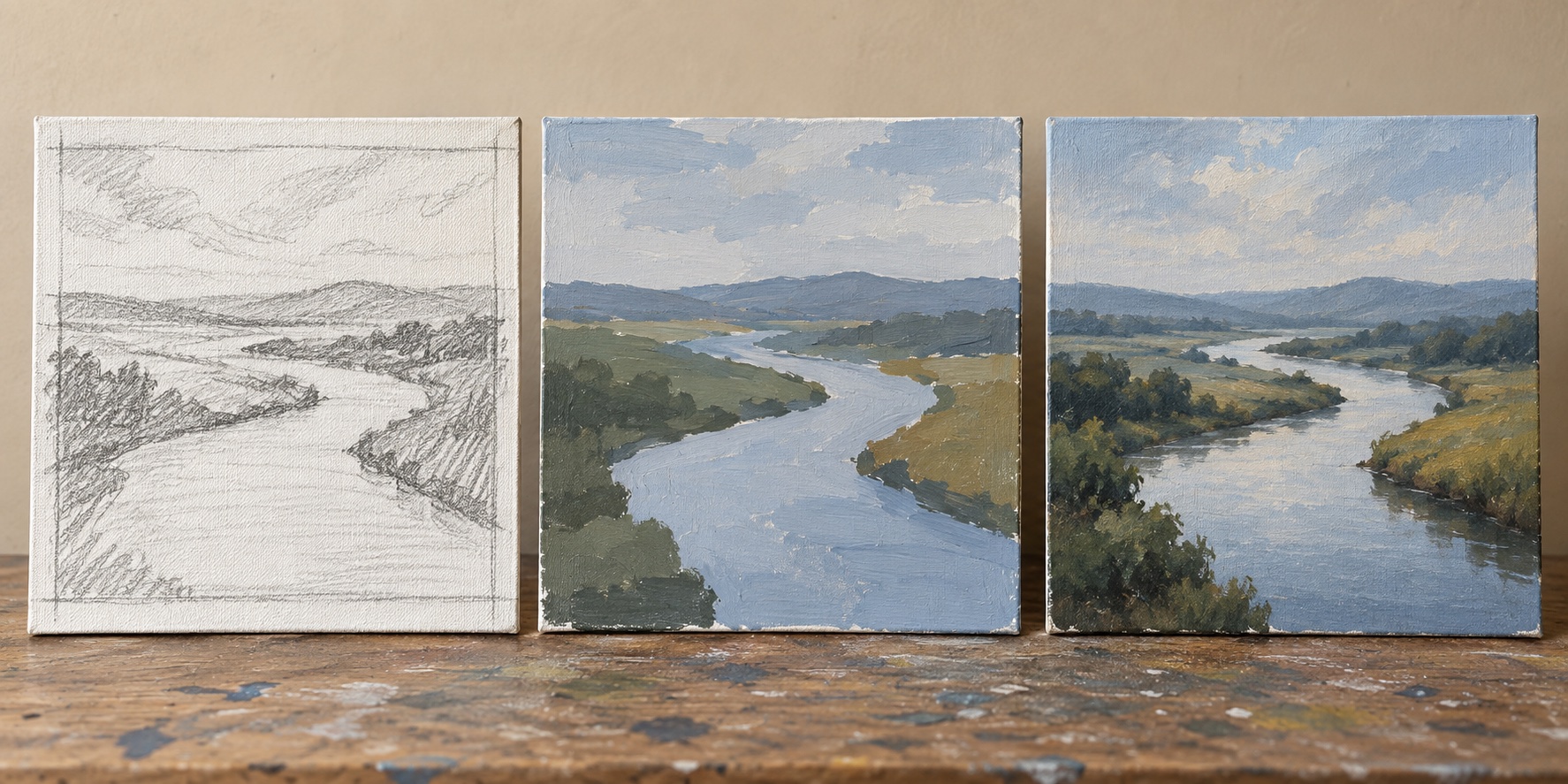
Failure mode and recovery: If the river appears to climb uphill, check whether it narrows toward the distance and whether far banks sit higher on the picture plane. If it looks pasted on, repeat bank colors lightly into the water and break selected edges with reflections.
6. Three-value mountain silhouette
Things you'll learn: How overlap and value separation create atmospheric depth with one hue.
Time: 40 to 55 minutes.
Materials: 7 x 10 inch panel or heavy paper; one dark pigment plus white; flat and filbert brushes; three palette piles; pencil; optional soft brush.
- Premix all three values. Make a pale, middle, and dark version of one hue and place swatches side by side. They should remain distinct when you squint. Reserve enough of each mixture to complete a whole ridge.
- Draw overlapping contours. Mark a high pale range, a lower middle ridge, and a foreground shape that enters from one or both bottom corners. Vary peaks and valleys without making evenly spaced triangles.
- Paint back to front. Fill the pale range first and soften part of its upper edge. Let it dry or settle before overlapping with the middle ridge. Finish with the darkest, sharpest foreground shape.
- Resist internal detail. Add at most one subtle value change to the middle ridge and a few interruptions to the foreground. The exercise succeeds through three large values, not mountain texture.
How to judge it: All three layers should remain separate from across the room, with the pale range feeling farthest away.
Failure mode and recovery: If two ridges merge, glaze the nearer one darker after drying. If every contour is equally sharp, soften part of the distant range with a thin veil of the sky mixture.
7. Full mountain range with foreground detail
Things you'll learn: How to coordinate four depth layers and keep detailed foreground marks from spreading everywhere.
Time: 2.5 to 4 hours.
Materials: 11 x 14 inch or larger panel; mountain reference; expanded earth-and-sky palette; large flat, medium filbert, bristle, and small round brushes; thumbnail paper; viewfinder.
- Edit the photograph in thumbnails. Make three value sketches with different crops. Combine small distant peaks, remove isolated trees, and choose one foreground area for texture. Pick the version whose depth reads without detail.
- Draw four large layers. Mark sky, distant range, middle slopes, and foreground. Check overlaps and the relative height of each layer. Keep any path, stream, or tree group subordinate to this structure.
- Paint from far to near. Use lighter, cooler, softer mixtures for the distant range. Increase warmth, value range, and edge clarity through the middle slopes into the foreground. Repeat a little sky color in every distant mixture to unify the atmosphere.
- Concentrate texture. Choose one foreground bank, rock group, or grass area and give it the clearest small marks. Echo only a few of those marks elsewhere. Step back, soften any middle-distance edge competing with the foreground, and remove detail if depth begins to flatten.
Failure mode and recovery: If every layer has the same contrast, mix a thin sky-colored glaze and push the far range back. If the foreground becomes noisy, repaint two adjacent texture patches into one larger quiet shape.
8. Multi-season triptych
Things you'll learn: How to keep composition and value structure consistent while color, edges, and surface cues change across a series.
Time: Three sessions of 75 to 120 minutes, plus preparation.
Materials: Three matching panels; one simple landscape reference; tracing paper or measured grid; seasonal palette notes; matching brush set; thumbnail paper; tape and ruler.
- Choose a composition with sturdy shapes. A tree, field, and distant ridge work better than a scene dependent on tiny seasonal details. Make one three-value thumbnail and decide which shapes remain identical across all panels.
- Transfer the same drawing. Use tracing paper, a measured grid, or matching landmarks to place the horizon and major shapes. Small natural differences are fine, but the tree, road, or ridge should occupy the same visual role.
- Assign seasonal systems. Choose three seasons and write a short palette and edge plan for each. Winter may be cool with crisp dark accents, spring softer and lighter, autumn warmer and higher in color contrast. Keep the underlying value hierarchy stable.
- Finish the panels side by side. Work the same stage across all three before advancing: skies, distant layers, foregrounds, then accents. Repeat several brush rhythms and edge placements so the group feels related. Let seasonal clues stay selective.
How to judge it: From a distance, the three panels should share one composition. Up close, palette, edge character, and a few specific cues should give each season its own atmosphere.
Failure mode and recovery: If one panel dominates, compare it in grayscale and reduce any value contrast not shared by the series. If the panels feel repetitive, change temperature and edge handling before adding more seasonal objects.
How to paint a landscape from memory
Painting from memory is less about proving you can remember a location and more about finding out what mattered to you. Write three things before painting: the dominant light, the largest shape, and one sensory detail. For example: pale evening sky, dark hill filling the lower third, dry grass moving left. That is enough to begin.
Make a three-value thumbnail without looking for a photograph. Use a familiar horizon and invent connecting shapes where memory is incomplete. Keep the first version small. If it feels empty, add one scale cue such as a path, tree, post, or distant roof, not an entire catalog of scenery.
The result does not need to match a map. A memory landscape is convincing when the value structure and atmosphere agree with one another. It can combine two real places and still feel more personal than a literal copy of either.
How to choose one reference and begin
Pick for the time available, not for the beauty of the photo. With half an hour, choose the horizon or three-value mountains. With an hour, choose the tree, foggy field, or sunset. Save the river and full mountain range for a longer block.
Then crop the reference in three ways. If the source shows a field, fence, farmhouse, road, trees, and distant hills, do not accept all six by default. For a one-hour painting, I would crop out the farmhouse, use the foggy-field project, and let one fence post carry the foreground. Spend most of the session on depth bands and edge loss, not object count.
If the block is broader than landscape and every reference seems equally possible, use What Should I Paint? A Decision Framework for Artists to choose by medium, time, audience, and finish level.
Finished the piece? What to do with it
Photograph the work square to the surface in even light and view it at several sizes. Wide landscapes can become thin decorative strips when printed too small, while a strong single-tree composition may hold up beautifully at a modest size.
Put the image in the WallMockup editor and compare the intended dimensions with the next size up. Check whether the depth layers and focal accent remain visible from normal room distance. If the work will be sold, why realistic mockups increase art sales explains why scale and context help a buyer picture the piece in a real space.
FAQ
What is an easy landscape painting idea for beginners?
A single horizon or one tree against open sky is an excellent start. Both limit the number of elements, making it easier to see whether proportion, value, and placement are working.
How do I draw a landscape before painting it?
Start with a two-inch thumbnail and divide the view into three values. Place the horizon, largest land shapes, and one focal or leading shape. Transfer those relationships to the painting surface before drawing trees, windows, rocks, or other details.
How do I make a landscape painting look less busy?
Choose one area for the sharpest edges and smallest marks, then combine repeated objects elsewhere into larger masses. Reduce contrast and detail with distance. If removing an element makes the main idea clearer, leave it out.
Can I paint a landscape without a reference photo?
Yes. Write down the dominant light, largest shape, and one memorable detail, then build a simple value thumbnail from those notes. Painting from memory naturally encourages selection, which is one of the central skills in landscape work.
What season is easiest to paint as a beginner?
Foggy or overcast scenes are forgiving because values stay close and many edges are naturally soft. Clear summer light can be equally useful, but it demands stronger decisions about cast shadows and color contrast.
What size should a landscape painting be?
Match size to the number of important shapes and the intended display. Simple horizons and one-tree studies can work small. Wide scenes with layered foreground detail usually need more physical width. Testing the image at scale before printing or framing removes much of the guesswork.
See also: The Complete Guide to Wall Art Mockups for how presentation fits into finishing, photographing, and selling a piece.