Updated: July 19, 2026 · 8 min read
Day 1 of an art challenge is easy; Day 11 is where the plan matters. This 30-day painting challenge starts with short material exercises, moves into subjects, and saves the repeated series for the final week. You do not need 30 flashes of inspiration - just one prompt small enough to finish on an ordinary weekday.
Table of Contents
- Why a 30-day painting challenge works
- How to structure your 30 days
- Week 1: Materials and mark-making
- Week 2: Color and value
- Week 3: Subject studies
- Week 4: Composition and a small series
- Rules that keep the challenge sustainable
- What to do when you miss a day
- A missed-day example that does not wreck the month
- Finished the month? What to do with your body of work
Why a 30-day painting challenge works
Daily practice gives you fast, frequent feedback, because the same problems repeat often enough to actually notice them. A single weekend painting might have three things wrong with it and no obvious cause. Thirty small paintings in a row make the same mistake obvious by day four.
The challenge also produces something a single painting can't: a body of work. Thirty small, related pieces read as a series in a way that thirty unrelated ones don't, which matters if you want something to show for the month beyond individual practice.
That's the main design choice in the structure below: the first three weeks build skills in isolation, and the fourth week deliberately repeats one subject so the month ends with a connected group instead of a scattered pile of studies. Starting with repeated finished subjects can make it harder to identify individual skill gaps, so Weeks 1-3 isolate those variables first.
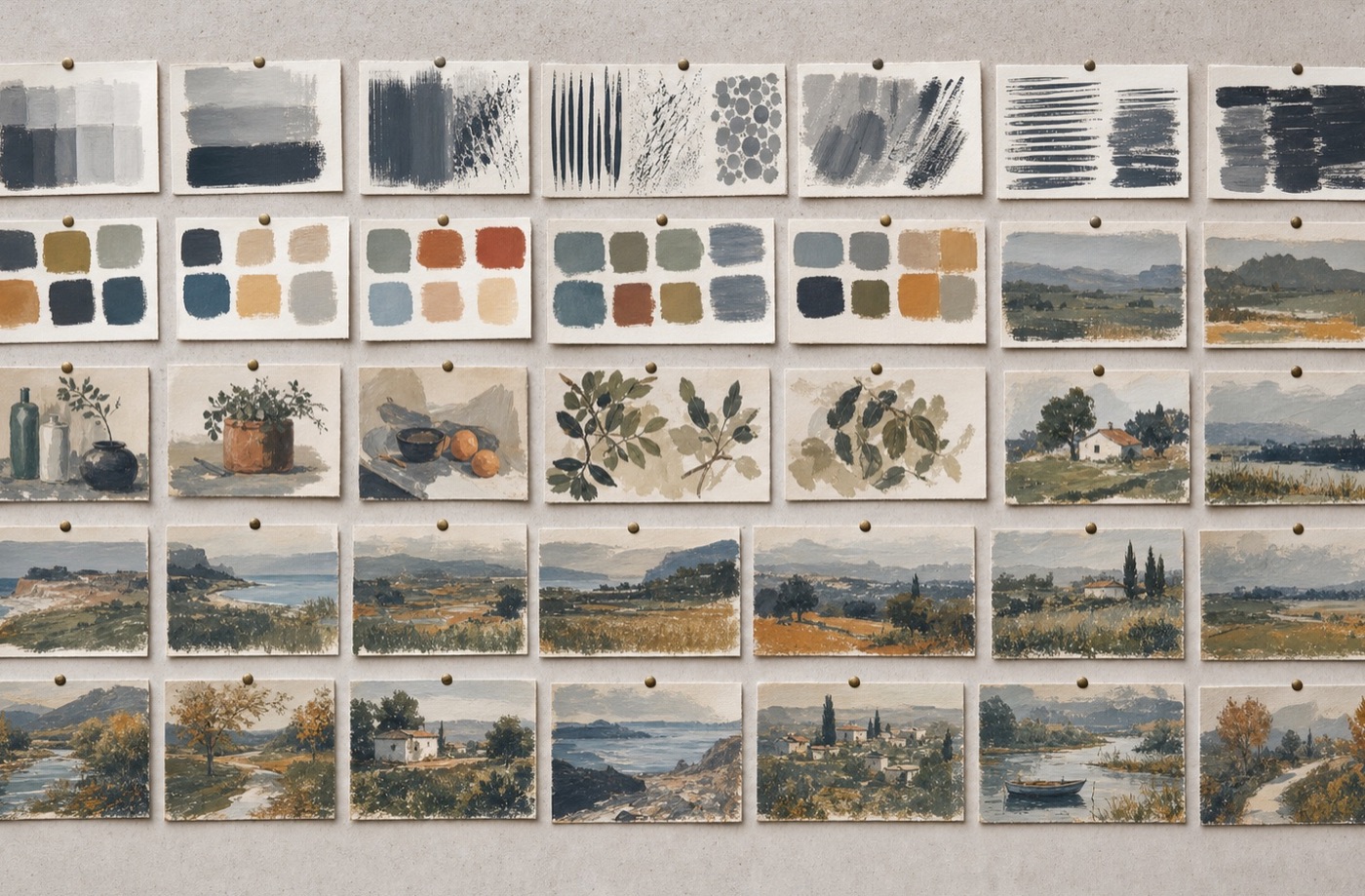
How to structure your 30 days
Split the month into four weeks, each with a specific focus, moving from the most basic skills toward a small connected series by the end. Keep each day's painting small (a quarter sheet, a 6x6 canvas, or similar) so a full day's prompt is achievable in 20-40 minutes.
- Week 1: materials and mark-making - get comfortable with tools before worrying about subject.
- Week 2: color and value - the two skills that affect every later painting most.
- Week 3: subject studies - apply the first two weeks to actual subjects.
- Week 4: composition and series - connect several days into one small cohesive group.
Week 1: Materials and mark-making
- Day 1 - Loosest possible warm-up. No plan, just marks, to see what your materials do.
- Day 2 - Straight lines only. No curves anywhere in the piece.
- Day 3 - Curves only. No straight lines anywhere in the piece.
- Day 4 - Dots and stipple marks. Build a full composition from small repeated marks.
- Day 5 - grab a tool you don't normally use. A palette knife, a rag, your fingers, whatever's lying around.
- Day 6 - Thick paint only. No thin washes or glazes today.
- Day 7 - Thin paint only. No opaque, heavy paint today.
Week 2: Color and value
- Day 8 - Value-only study. Black, white, and gray, no color.
- Day 9 - Two-color painting. One warm, one cool, nothing else.
- Day 10 - Complementary clash. Two opposite colors pushed to full saturation.
- Day 11 - Monochrome study. One hue from near-white to near-black.
- Day 12 - A color you dislike. Build the whole piece around it.
- Day 13 - Gradient only. One smooth color transition, no hard edges.
- Day 14 - Found palette. Pull colors from a photo on your phone.
Week 3: Subject studies
- Day 15 - A single piece of fruit or object.
- Day 16 - A cup or mug on a table.
- Day 17 - A single leaf or plant.
- Day 18 - A window or doorway.
- Day 19 - A shoe or piece of clothing.
- Day 20 - whatever you can see from where you're sitting right now. Don't get up to find something better.
- Day 21 - The same subject as Day 15, painted differently.
Week 4: Composition and a small series
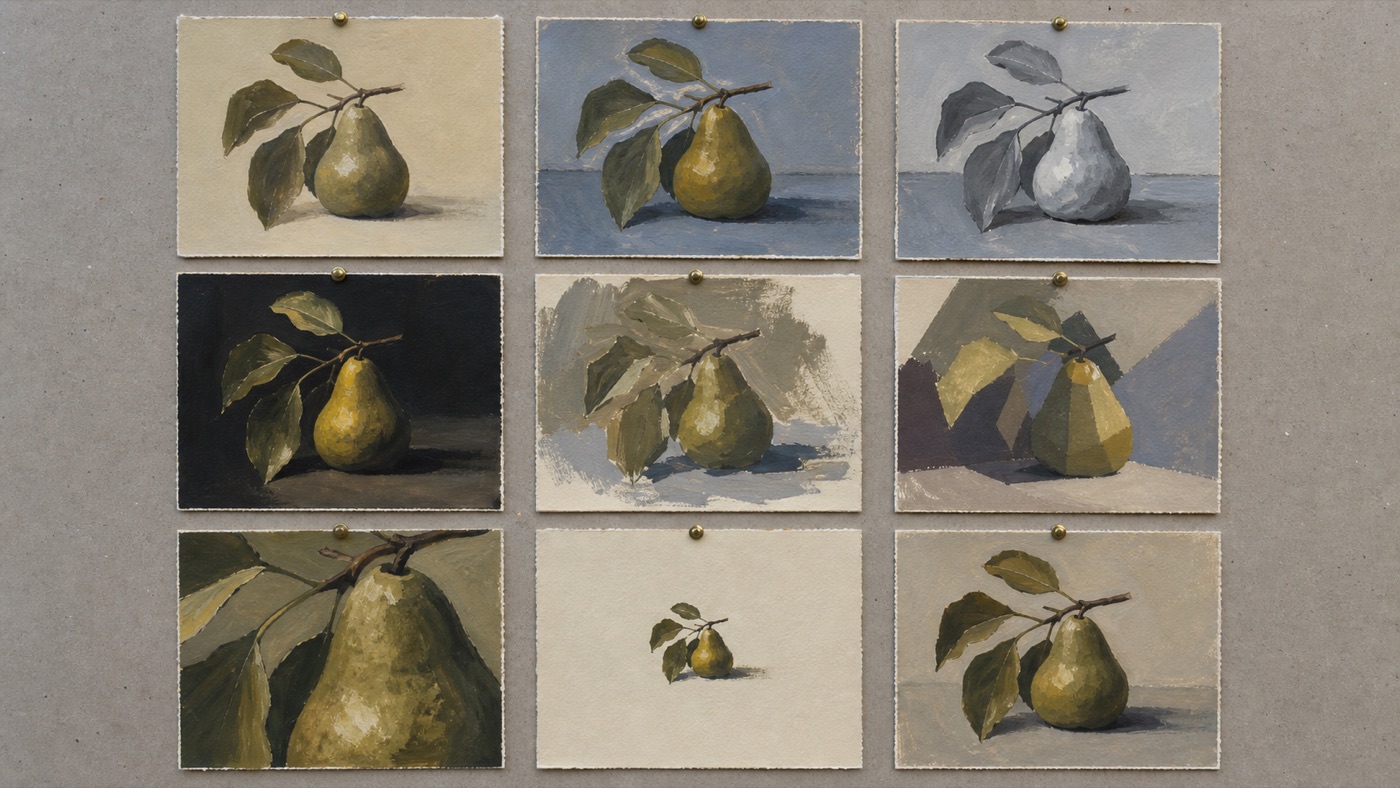
- Day 22 - Pick one subject from Week 3 to repeat for the rest of the month.
- Day 23 - Same subject, different color palette.
- Day 24 - Same subject, different composition (zoomed in, off-center, cropped).
- Day 25 - Same subject, different medium if you have one available.
- Day 26 - Same subject, high contrast values only.
- Day 27 - Same subject, low contrast/muted values only.
- Day 28 - Same subject, largest version you've painted all month.
- Day 29 - Same subject, smallest version you've painted all month.
- Day 30 - Your favorite version from the month, painted once more with everything you've learned.
By the end of Week 4 you'll have a small series built around one subject rather than 30 disconnected pieces, which is what makes the last week feel like a payoff instead of just more practice.
Rules that keep the challenge sustainable
- Cap the time. 20-40 minutes per day, hard stop. A challenge that requires two hours daily won't survive a busy week.
- Small surfaces only. A quarter sheet or 6x6 canvas keeps the daily commitment realistic.
- No perfectionism rule. Every piece counts as a completed day regardless of how it turned out - the goal is the practice, not 30 finished masterpieces.
- Track completion, not quality. A simple checklist or calendar you mark off is more motivating mid-month than judging each piece.
- Photograph each day, even quickly, so you can look back at the progression at the end.
What to do when you miss a day
You will probably miss at least one day in 30 - plan for it instead of treating it as a failure that ends the challenge. Two workable options:
- Skip and continue. Move to the next day's prompt and keep going; the sequence still works even with a gap.
- Double up. Do the missed prompt and the current day's prompt back to back, if time allows.
Either is fine. The only version that actually derails the challenge is quitting entirely because one day was missed - a 27-day challenge with three skipped days still produces most of the benefit of a full 30.
It helps to decide your fallback rule before the month starts rather than in the moment, since "skip and continue" versus "double up" is an easier decision when you're not also feeling behind. Either approach can work; choosing one in advance removes a decision that might otherwise interrupt the challenge.
One more thing worth deciding up front: what counts as "done" for a daily piece. If you wait until each one feels finished, some days will run long and others will get skipped entirely. Set a simple rule instead - the piece is done when the timer runs out or the day's variable has been tried, whichever comes first. You can always revisit a favorite later; the challenge itself doesn't need every piece to be a keeper.
A missed-day example that does not wreck the month
Suppose Day 12 disappears into work and you have only 35 minutes on Day 13. Do not squeeze two complete paintings into that window. Spend 10 minutes making Day 12's disliked color into three mixtures, then use those mixtures for Day 13's gradient. Mark both prompts attempted and return to the normal schedule on Day 14. The sequence stays intact, and one busy day becomes a combined exercise rather than a test of willpower.
Finished the month? What to do with your body of work
Judge Week 4 as a group before choosing a single "winner." Use the WallMockup editor to arrange the repeated subject as a three- or four-piece row at the dimensions you painted. Uneven spacing, one unusually dark panel, or a palette that breaks the series is easier to spot in the group than in separate photos.
If you're planning to sell any of the series, that grouped, true-to-scale view is also what helps a buyer understand the pieces as a set instead of individually - see why realistic mockups increase art sales for more on that.
If you're not sure which single piece to develop further once the challenge ends, What Should I Paint? A Decision Framework for Artists is a useful next step for picking your next subject deliberately instead of starting the whole search over.
FAQ
How long should each painting take in a 30-day challenge?
For this plan, 20 to 40 minutes per day is the target. Longer sessions are fine occasionally, but a challenge that requires hours every day may be difficult to maintain during a busy week.
What size should I paint for a daily challenge?
Small - a quarter sheet of paper or a 6x6 canvas works well. Small surfaces keep the daily time commitment realistic and make 30 days of storage manageable.
What happens if I miss a day in the challenge?
Skip the missed day and continue with the next prompt, or double up and do both prompts in one sitting if you have time. Either option keeps the challenge intact; quitting over one missed day loses most of the benefit.
Do I need 30 different subjects for a painting challenge?
No. The structure above intentionally repeats one subject through the final week so the last week produces a connected series instead of 30 disconnected studies.
What should I do with 30 paintings once the challenge is done?
Review them as a group rather than individually, especially the final week's series. A grouped, true-to-scale mockup on a wall will show you which pieces work together and which stand alone.
Can I do this challenge with only one medium?
Yes, and it's usually easier than switching between mediums mid-month. The structure works with acrylic, watercolor, gouache, or oil on their own - just adjust the daily time estimate up if your medium has a slow drying time between layers.
See also: The Complete Guide to Wall Art Mockups for how presentation fits into finishing and eventually sharing or selling a body of work.